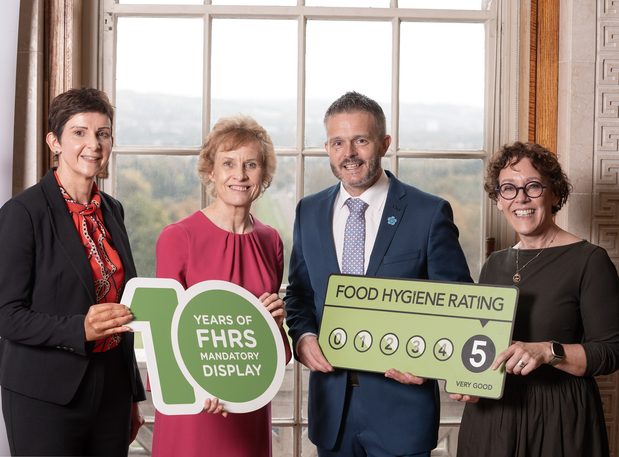
As Northern Ireland marks ten years of mandatory Food Hygiene Rating display, we spoke to Kathryn Baker, Chief Environmental Health Officer at the Department of Health in Northern Ireland, about the development of the scheme, the importance of transparency and the people who have helped make it a success.
When choosing somewhere to eat, many of us look for the familiar green and black Food Hygiene Rating sticker displayed at food businesses. But ten years ago, displaying that rating wasn’t a legal requirement in Northern Ireland.
Today, the sticker is an established part of the food landscape, giving customers information about the hygiene standards found when a business was inspected.
For Kathryn Baker, who previously worked at the Food Standards Agency (FSA), leading on the Food Hygiene Rating Scheme in Northern Ireland, the tenth anniversary is a particularly meaningful milestone.
“The food hygiene rating scheme is very close to my heart, because before I joined the Department of Health, I worked in the Food Standards Agency and for many years I led on the development of the scheme in Northern Ireland.”
A decade of progress
The Food Hygiene Rating Scheme was introduced in Northern Ireland in 2010, with the FSA working alongside district councils to provide consumers with clear information about food hygiene standards.
The principle was straightforward: businesses would receive a rating from 0 to 5, giving consumers an easy way to understand the hygiene standards of a business.
However, while businesses were awarded ratings and consumers could check them online, displaying the rating at the premises was initially voluntary.
By 2013, evidence of the scheme’s impact was beginning to emerge, with 54% of businesses achieving the highest rating of 5.
In the years that followed, the proportion of businesses achieving the top rating continued to increase. By 2016, 70% of businesses were achieving a rating of 5, with the figure rising to 84% by 2026.
For Kathryn, that progress is an achievement worth recognising.
“That is a remarkable increase — and an achievement that belongs first and foremost to the food businesses and their staff who have worked hard to raise and maintain standards.”
But a significant change in 2016 helped make those standards more visible to consumers.
Ten years of transparency
On 7 October 2016, the Food Hygiene Rating Act (Northern Ireland) 2016 came into operation, making it a legal requirement for rated food businesses to display their Food Hygiene Rating.
Kathryn explained how this marked an important turning point in making food hygiene information more accessible.
“Before mandatory display, businesses were given ratings and consumers could access that information. But mandatory display put that information directly in front of the customer.”
“You didn’t need to search a website. You didn’t need to know that a rating existed. You simply walked through the door and it was there.”
The change meant that customers could see a business’s rating before deciding whether to eat there, while businesses had a visible way to demonstrate their hygiene standards.
A Food Hygiene Rating tells customers about the hygiene standards found at the time a business was inspected. Environmental Health Officers assess how food is handled, the cleanliness and condition of the premises, and how food safety is managed.
Businesses receive a rating from 0 to 5, with 5 indicating very good hygiene standards. The rating is not a review of the taste or quality of the food or the service provided. Instead, it gives people information to help them make informed choices about where they eat or order food.
Kathryn believes making this information visible has been one of the scheme’s most important achievements.
“That approach has helped create a culture where good food hygiene is not something that happens behind the scenes.”
“It is something businesses can demonstrate publicly. And consumers can see.”
A scheme recognised across Northern Ireland
Ten years on, the familiar green and black sticker has become widely recognised.
According to the FSA’s Food and You 2 research, 93% of people in Northern Ireland had heard of the Food Hygiene Rating Scheme, while 95% recognised the rating sticker when shown it.
Research also found that 49% of people in Northern Ireland who eat out had checked a food business’s hygiene rating in the previous 12 months.
For Kathryn, these findings demonstrate the importance of making food hygiene information available to everyone.
“The rating is therefore doing exactly what it was intended to do: giving people information that helps them make informed choices.”
The scheme has become part of everyday life, helping consumers consider hygiene standards when deciding where to eat.
A partnership that works
While mandatory display has played an important role in the scheme’s development, Kathryn is clear that legislation alone cannot explain its success.
“But the food hygiene rating scheme cannot succeed through legislation alone. The real success story is the partnership and the people behind it.”
Northern Ireland’s eleven district councils and their Environmental Health Officers are at the heart of the scheme.
They carry out inspections, assess hygiene standards and work directly with businesses, while the FSA provides the framework and works with councils to ensure consistency.
Kathryn is keen to recognise the commitment of those involved.
“Our district councils and their environmental health professionals are at the heart of the system and I want to pay tribute to the Environmental Health Officers and food safety teams across Northern Ireland’s councils.”
“They inspect food businesses, assess compliance, provide advice and take enforcement action where necessary. Their role is vital and ultimately, it’s about protecting the public.”
Kathryn also recognises the work that takes place every day within food businesses to maintain good hygiene standards.
“Behind every rating is a team of people cleaning premises, controlling temperatures, preventing cross-contamination, managing food safety, training staff and putting effective food safety procedures into practice.”
“A rating of 5 doesn’t happen by accident. It reflects a sustained commitment to doing things properly.”
For Kathryn, the progress made over the past decade belongs to everyone who has contributed to making food hygiene standards more visible and helping consumers make informed choices.
Looking ahead to the next ten years
As the way people buy and order food continues to evolve, making food hygiene information accessible remains just as important.
Customers are increasingly making decisions online, whether booking a restaurant, ordering a takeaway or choosing somewhere new to eat.
Kathryn recognises a challenge for the years ahead is ensuring people continue to have access to the information they need, wherever they choose to buy food.
“Over the next ten years, our task is to make sure that same confidence follows consumers wherever they choose to buy their food, whether that be in person or online.”
And while the scheme has developed considerably since its introduction, its underlying purpose remains unchanged.
“When people have information, they can make informed choices and when businesses know that high standards are visible, there is a powerful incentive to maintain them.”
For Kathryn, ten years of mandatory Food Hygiene Rating display is about more than the familiar green and black sticker. It represents a decade of greater transparency, partnership and commitment to food hygiene standards across Northern Ireland.
“Because food safety is not simply about meeting a standard. It’s about earning the public’s trust.”
Check before you choose
Whether you’re visiting a restaurant, café or takeaway, look for the green and black Food Hygiene Rating sticker or check the business’s rating online at food.gov.uk/ratings.
Remember, a Food Hygiene Rating tells you about the hygiene standards found at the time of inspection, helping you make an informed choice.
Leave a comment